[OC-Investment] December Contest

Summary

This proposal seeks approval to allocate $300,000 from gTrade’s overcollateralization layers (OC) to fund a December trading competition, running for approximately three weeks and concluding before the end of this year.

Given that the community discussions reflected mixed but strong appetite across different contest formats, this proposal does not prescribe a fixed structure. Instead, it presents multiple structure options for Snapshot voters to choose from.

The Snapshot vote will include the following options:

  • $300k — Hybrid (PnL + time-weighted volume)

  • $300k — Time-weighted volume only

  • $300k — PnL-only

  • No contest

Structure rules:

  • “No contest” only passes if it receives >50% of total votes.

  • Otherwise, whichever option among the three contest formats receives the highest votes will be implemented.

If approved, the OC-pull will be executed immediately so the contest can begin in early December.

Context & Background

1. Trick or Trade Retrospective (High-Level)

After the Trick or Trade campaign (Oct 22 - Nov 19), a retrospective was published as an addendum on the governance forum to inform GNS holders on the its impact, ROI, and key takeaways.

Key outcomes (see Dune for more):

  • 2.2x total volume vs. prior 30 days

  • 2.75x core volume

  • 2x fees, with fee ROI landing around 1:1 (or 1.2x excluding excess marketing costs)

  • +$130K total vault PnL, +$260K core vault PnL

  • 750,000+ GNS burned (≈2.75% of supply at the time writing)

  • Material increase in core OI, validating the v10 funding-fee model

  • Strong sentiment improvement and community engagement

  • Completion of the milestone required to unlock a $150k grant

    • Team commits to using these grant funds for a Q1 2026 Arbitrum-exclusive contest

In short: Trick or Trade laid a strong foundation for v10 by demonstrating healthier market behavior, stronger economics, and the conditions needed to compound growth going forward.

2. Community Temperature Check (Telegram: Nov 24–25, 2025)

A two-part poll was conducted to assess appetite for a December contest, its size, and potential structures:

Final results of the community temperature check on Telegram (November 26, 2025)

Community consensus clearly favors a meaningful December contest but is somewhat divided on structure.

Based on the Trick or Trade results, its learnings outlined in the retrospective, and the current state of the OC layers — the team shares the community’s preference and is confident that a $300k contest is an appropriate and sustainable next step. Additionally, the team is slightly in favor of a hybrid contest structure.
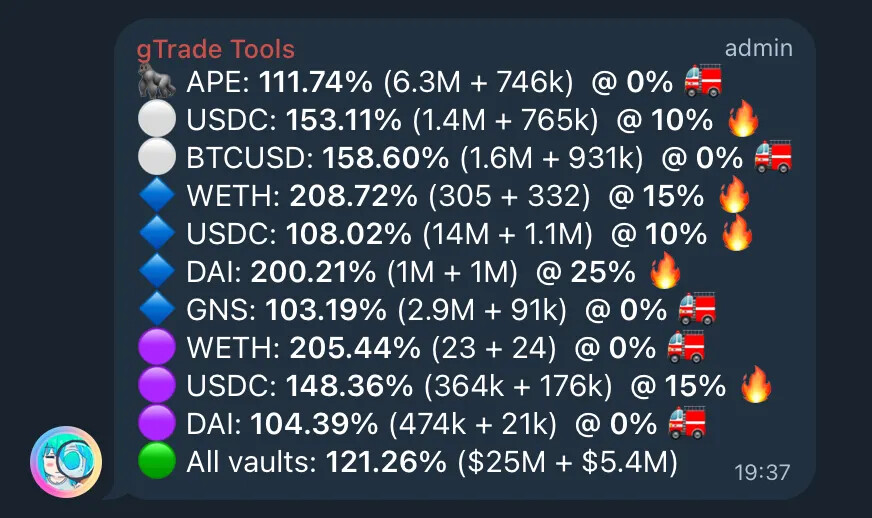
Current state of gTrade’s vaults and OC-layers (November 26, 2025)

Rationale for a December Contest

1. Sustain v10’s Momentum

v10 materially changed gTrade’s market dynamics:

  • Funding fees on core markets now hedge risk more effectively

  • Core markets can absorb significantly more demand and volatility

  • OI limits were gradually increased during Trick or Trade as risk was balanced via arbitrage participation

  • Traders have begun experiencing gTrade as a platform that supports longer-held directional trades

A December contest leverages this momentum rather than letting it dissipate into year-end.

2. Strong Token-Level Alignment via BB&B

At current market prices and BB&B active, an OC-funded contest effectively acts as an indirect accelerant for token-level alignment:

  • More volume → more fees → more BB&B → greater GNS deflation

  • Fees + PnL from core markets continue to strengthen protocol economics

3. Bridge to Q1 Campaign

The protocol has successfully unlocked a $150k grant on Arbitrum, but:

  • KYB is complete

  • Funds have not yet been transferred

  • Timelines are too tight to rely on the grant for a December campaign

Thus, an OC-funded December contest serves as a bridge event, followed by another major Arbitrum-exclusive campaign in Q1 2026 using the grant.

4. Retention of Newly (Re)activated Traders

Trick or Trade brought back dormant or churned users.

To retain them, the follow-up must be:

  • Timely

  • Familiar (with similar mechanics)

  • Sized meaningfully enough to justify continued activity

    • eg. relative to alternative incentive opportunities available across the perp DEX vertical, previously outlined in “Market Context & Rationale,” which continues to be relevant for this December campaign.

A December campaign ensures the activity curve remains elevated going into Q1.

Details of Proposed December Contest

Contest Duration

  • ~3 weeks, ending before EOY

Eligible Networks

  • Arbitrum

    • and gTrade Solana

Collateral Eligibility

  • USDC on Arbitrum

Requested Action

This proposal seeks community approval via Snapshot to allocate $300,000 from the OC layers to fund a December contest.

Voters will choose between:

  1. $300k — Hybrid (PnL + time-weighted volume)

  2. $300k — Time-weighted volume only

  3. $300k — PnL-only

  4. No contest

Decision rule:

  • “No contest” must receive >50% of all votes to win

  • Otherwise, the highest-voted contest structure is adopted

If passed, the contest implementation begins immediately.

Conclusion

The community has shown overwhelming support for another contest, and Trick or Trade demonstrated that:

  • v10 is delivering the intended behavior shift

  • The contest model works

  • Traders, GNS holders, and the protocol all benefit

  • Competitive pressure across perp DEXs remains high

  • Maintaining momentum into EOY and Q1 is strategically important

This proposal empowers GNS holders to choose the format they prefer while ensuring momentum continues into the holiday period and into the Q1 Arbitrum-funded campaign.

We invite all GNS holders to participate in this Snapshot vote and help shape the next phase of gTrade’s growth.

1 Like

This addendum provides a high-level retrospective of the Naughty or Nice trading competition, which ran from December 3 to December 24 with a total prize pool of $320,000, funded from the overcollateralization (OC) layers following community approval.*

*Note that the additional $20,000 was funded from gov fund

The contest followed a hybrid structure:

  • $130,000 — Absolute PnL leaderboard

    • Top 50 traders

    • All pairs eligible

    • USDC (Arbitrum) as the sole eligible collateral

  • $190,000 — Time-weighted volume rewards

    • Top 300 traders

    • Core pairs only (v10 funding-fee markets)

    • Volume weighted by trade duration, with multipliers incentivizing longer-held positions

The primary objectives were to extend the momentum of v10 and the Trick or Trade contest in Oct/Nov, further encourage sustainable trading behavior, and continue shifting gTrade’s activity profile away from ultra-short-term scalping toward longer-held directional trades, while maintaining platform health during the year-end period. Additionally, the goal was to continue the pace $GNS buybacks & burns while token price was considered low enough to indirectly invest in supply reductions through trading rewards.

Refer to this Dune dashboard for more data insights.

1. Performance Overview (vs. Trick or Trade baseline)

Trader Retention

Trader retention between campaigns was constructive. Comparing Trick or Trade to Naughty or Nice:

  • approximately 50% of participating addresses returned,

  • while ~60% of total volume during Naughty or Nice came from returning traders.

Notably, 22 of the top 30 Trick or Trade traders re-engaged, representing a ~73% retention rate among high-value participants.

While absolute growth varied across segments, this retention supports the thesis that sustained and / or well-timed incentive programs can meaningfully extend trader engagement and reinforce gTrade as a repeat venue for competition rather than a one-off destination.

Volume

To avoid distortions caused by overlapping incentive periods, this section compares average daily performance during Naughty or Nice (December contest) directly against average daily performance during Trick or Trade (October contest).

This provides a clearer, like-for-like assessment of how the December campaign performed relative to the October campaign that was previously deemed a modest success.

  • Total average daily volume: Higher during Naughty or Nice than Trick or Trade

  • Core average daily volume: Lower during Naughty or Nice compared to Trick or Trade

In practice, this means:

  • Aggregate platform volume continued to grow in December

  • However, a larger share of that volume shifted away from core (v10 funding-fee) markets

This divergence was primarily driven by:

  • Concentrated activity from a small number of large traders on non-core pairs (notably SOLDEGEN)

  • Incentive mechanics that proved less effective at materially scaling core volume during this period

The volume increase was highly concentrated, driven in large part by:

  • A large trader trading XAG (silver) aggressively during December

  • Elevated (SOL)DEGEN activity from a loyal set of traders who arguably didn’t care as much about the contest.

  • Elevated activity in commodities and RWAs, particularly silver, which broke all-time highs repeatedly during the contest window

So, while total volume increased meaningfully, core pair volume declined relative to the Otober contest baseline. This suggests that:

  • Time-weighted volume incentives alone were not sufficient to materially grow volume on core pairs during this period

  • Incremental volume was largely driven by non-core activity (ie. DEGEN) and a small number of large traders whose behavior was likely independent of the incentive design (time-weighted volume rewards in particular)

These divergences are important learnings for future contests.

Lastly, external factors might have played a factor in arbitrage activity shifting away from gTrade as:

  1. Lighter’s TGE was approaching (ie. urgency for traders to finish points farming)

  2. Variational capturing market share during the same period and traders shifting focus there

Fees

  • Total average daily fees: Largely flat between Naughty or Nice and Trick or Trade

  • Core average daily fees: Meaningfully lower during Naughty or Nice

While total fees remained flat, core fees declined significantly for the December contest. This was primarily due to:

  • A lower share of overall activity occurring on core markets as described above

  • 50% fee discounts applied to select popular “Featured Pairs” (notably XAG and XAU)

    • A conscious trade-off to promote competitive trading conditions and support marketing efforts [Example 1, Example 2]

While fee discounts likely reduced short-term revenue capture, they have been instrumental in attracting large commodity traders. However, in hindsight, combining:

  • a $300k incentive program and

  • aggressive fee discounts

may have been over-incentivization for these pairs. Whether the same volume would have materialized without the discounts remains unclear. Team will continue the Featured Pairs series for hot pairs until clear signs show otherwise.

Summary

Relative to Trick or Trade:

  • Naughty or Nice sustained — and slightly increased — total platform volume

  • Core volume and core fees declined

  • Overall fee generation remained broadly stable despite heavier incentives

Taken together, this reinforces that:

  • Incentives successfully preserved platform-wide activity during a challenging, year-end period

  • However, the incentive stack used in December was less effective at driving core market growth than during Trick or Trade

This outcome informs future contest design, particularly around:

  • Calibrating incentive strength versus fee discounts

  • Ensuring incentives translate into sustained core market usage rather than non-core concentration

  • Aligning contest mechanics more tightly with v10’s primary economic objectives

Industry Context (GMX Benchmark)

For additional context, GMX experienced a material slowdown over the same periods. Between Trick or Trade and Naughty or Nice, GMX’s average activity declined meaningfully, with ~33% lower volume and fees (from ~$255M / $152K during ToT to ~$176M / $104K during NoN).

Against this backdrop, gTrade’s performance compares favorably. While Naughty or Nice did not outperform Trick or Trade on all internal dimensions, average daily fees remained roughly flat and average daily volume increased ~1.5x, indicating that the contest helped sustain platform activity through a seasonally weak, year-end environment where comparable venues saw clear drawdowns.

This suggests the campaign functioned effectively as a defensive retention and activity-stabilization mechanism, even where absolute growth on core metrics fell short of earlier peaks.

2. Open Interest, Exposure & Market Health

Open Interest (OI)

Compared to Trick or Trade, OI churn was materially lower during Naughty or Nice.

Key reason:

  • Trades were not required to be closed for rewards to be counted

  • Open PnL was snapshotted instead

This resulted in:

  • More stable OI around contest end

  • Better UX for swing and position traders

  • Healthier behavior on core markets, aligned with v10’s design goals

OI churn post Trick or Trade (Nov 19):

OI churn post Naughty or Nice (Dec 23):

Exposure

  • Exposure across both total and core markets remained relatively balanced

    • Confirms that v10’s funding-fee + arbitrage dynamics continue to manage risk effectively, even during incentive periods

Importantly, the transition of silver (XAG) and gold (XAU) to the v10 core model materially improved gTrade’s exposure profile.

Commodity exposure [Trick or Trade]:

Commodity exposure [Naughty or Nice]:

As shown during both contests, funding fees and arbitrage participation significantly reduced sustained directional exposure on commodities. This trend continued throughout Naughty or Nice, where exposure spikes still occurred but were generally contained within ±$500k, even during periods of elevated volatility and record trading activity.

This confirms that v10 enables commodity markets to scale safely under higher demand, reinforcing gTrade’s ability to offer competitive, deep liquidity on RWAs through its oracle-based AMM design going into 2026.

3. GNS Burns & OC Considerations

GNS Burns

  • Total burned during contest: 251,201 GNS

This burn level was significantly lower than during Trick or Trade (750,000+ GNS but note that contest was subject to a longer contest period and larger prize pool)

Contributing factors:

  • Lower relative fee generation

  • Reduced BB&B allocation from trader losses during the contest

    • This was intentionally adjusted to help rebuild OC buffers

Vault PnL & OC Dynamics

During Naughty or Nice, aggregate trader PnL slightly exceeded vault PnL, resulting in a net vault loss of ~$23K across the contest.

This headline figure, however, masks a clear split between market types:

  • Core markets generated ~$250K in positive vault PnL

  • Vault losses were concentrated in non-core (mostly DEGEN) markets, which cannot be effectively hedged

This reinforces a key structural takeaway:

Incentivizing v10 core markets drives healthier, OC-accretive activity, supported by funding fees and arbitrage, while broad PnL incentives across all pairs increase risk on non-hedgeable markets.

Going forward, contest designs should increasingly bias incentives toward core-market activity when OC growth and platform sustainability are primary objectives.

4. Traders, Integrators & Referrals

Trader Activity

  • Active trader counts declined steadily through December

  • This contrasts with Trick or Trade, where integrator activity (notably Vooi) sustained participation

Primary drivers:

  • Less inorganic behavior from contest farmers (see “6. Inorganic Activity & Contest Integrity”)

  • Vooi TGE proximity, reducing points-farming activity on their venue

  • Shorter preparation runway for integrators

  • Holiday seasonality

Trader count and avg. volume per trader [Naughty or Nice]:

Integrator Impact

Integrator participation was materially lower than during Trick or Trade:

  • Less referral volume

  • Fewer co-marketing pushes

  • Visible decline in referral fee generation

    • Again, mostly due to Vooi activity declining after their TGE

This reinforces that:

  • Integrators can be a major amplifier of outcomes when timelines and incentives align

  • Short-notice campaigns near holidays carry higher execution risk

  • Lead time matters significantly for coordinated growth efforts

5. Outreach & Whitelisting Efforts

Direct outreach to large traders from other venues yielded modest but positive results:

  • Several addresses activated or increased activity post-outreach

  • Conversion rates remain low, but directionally improving

Efforts included:

  • Social media posts [Example 1, Example 2]

  • DMs through socials, addresses

  • Whitelisting

  • Front-end notifications

These efforts will continue while improving pipeline for higher conversion, with a focus on white-glove engagement in exchange for feedback and sustained activity.

6. Inorganic Activity & Contest Integrity

Naughty or Nice showed material improvement versus Trick or Trade in managing inorganic behavior:

  • 2 identifiable clusters >3 wallets

  • 2 robust delta-neutral farming strategies

  • ~11% of raw rewards initially flagged

    • Reduced to <2% of final rewards after dqs

Compared to Trick or Trade:

  • ~40% of PnL leaderboard was initially inorganic (before clean-up)

  • Cleanup effort was significantly heavier

Clearer rules resulted in:

  • Less admin overhead

  • Higher confidence for organic traders

  • Reduced headline metrics, but higher integrity

The trade-off remains deliberate:

  • Allow some inorganic activity where it remains fee-positive [esp. volume rewards]

  • Ensure organic traders receive the majority of rewards [esp. PnL rewards]

7. What Worked & What Didn’t

What Worked

  • Improved contest design

    • No forced close-outs

    • Healthier OI behavior

  • Reduced sybil pressure

  • Strong performance of RWA markets

    • Especially XAG and XAU

    • Confirms RWAs should be a key strategic pillar for 2026

  • v10 market mechanics

    • Stable exposure

    • Arbitrage-supported OI scaling

What Didn’t Work as Well

  • Core volume growth

    • Average core volume declined versus Trick or Trade

    • Time-weighted incentives alone were insufficient

  • Fee capture

    • Core fees declined meaningfully relative to Trick or Trade

    • Partly by concurrent fee discounts

  • Integrator participation

    • Lower due to reduced runway and misalignment of timelines
  • Overall sentiment

    • Perceived as weaker than Trick or Trade on headline metrics

8. Key Learnings & Forward Strategy

  • Incentive stacking (rewards + fee discounts) needs tighter calibration

  • RWAs and commodities deserve dedicated focus going forward

  • Increase focus toward white-glove BD efforts to lock in high-value traders and continuous feedback loops

  • Integrator alignment can be critical for contest success

  • Contest UX improvements (PnL snapshotting) materially improve OI health

  • Lower inorganic activity improves trust, even if it reduces surface-level metrics

Next Steps

  • Deepen RWA / commodity market investment in 2026

  • Transition more RWAs into the v10 core model

  • Design contests with:

    • Longer preparation runways

    • Clearer integrator commitments

    • More targeted incentive allocation

  • Prepare for Q1 contest with Arbitrum-grant